How FebriDx® Fits Into Your Existing Workflow
Adopting FebriDx without disrupting care delivery and supporting operational efficiency in acute respiratory settings
The Reality of Acute Respiratory Visits
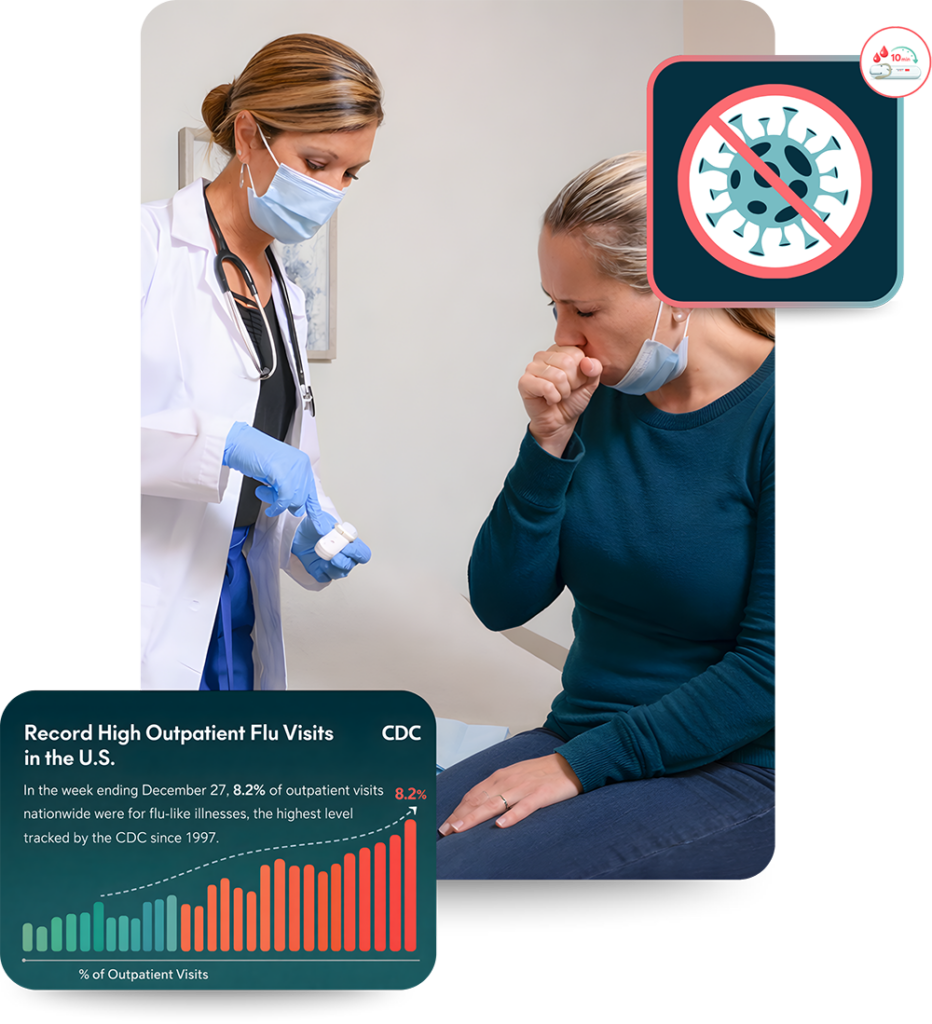
In urgent care centers and emergency departments, patients commonly present with respiratory symptoms such as cough, fever, sore throat, or fatigue.
Early in the visit, clinicians must make critical decisions:
- Is this likely bacterial or non-bacterial?
- Are antibiotics appropriate?
- Which tests, if any, should be ordered?
- How do I clearly explain the plan to the patient?
In many cases:
- An initial clinical assessment is performed
- Standard rapid tests (e.g., COVID-19, influenza, strep) may be ordered
- Results often return in 10–15 minutes
Even when these tests are negative, uncertainty around treatment decisions can persist. Prescribing confidence may be limited, and patient communication often requires additional time and explanation.
This is often where visits become more time-consuming — not because of clinical complexity, but because diagnostic uncertainty remains.
Where FebriDx Fits
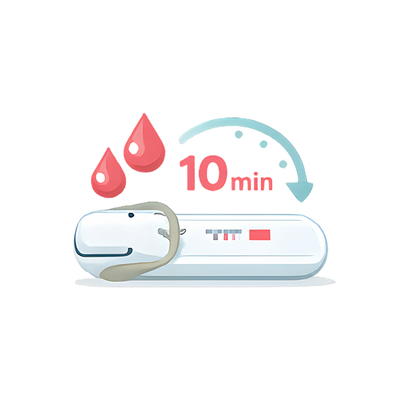
FebriDx is used during the same visit, while the patient is still in the room.
Fingerstick sample
Results in 10-15 Minutes
No analyzer or lab send-out
By evaluating the patient’s host immune response, FebriDx provides additional context helping clinicians move forward with greater confidence.
A Practical View of Workflow Integration

Step 1
Patient Evaluation Proceeds as Usual
- Clinical history, vitals, and physical examination are completed according to standard practice. Additional testing is ordered as clinically appropriate.
Step 2
FebriDx Is Integrated Into the Clinical Assessment
- FebriDx may be used early in the visit or alongside other evaluations to support assessment of the underlying immune response.
Step 3
Simple Sample Collection
- A small fingerstick capillary blood sample is obtained. No venipuncture. No lab send-out.
Step 4
Results While the Patient Is Still Present
- Results are available in 10–15 minutes and can be reviewed during the same visit.
Step 5
Clinical Decision-Making Is Supported
- Results are interpreted in the context of clinical findings and may help guide next steps, including treatment decisions or further testing. Final decisions always remain with the clinician

What Does Not Change
Adopting FebriDx does not require fundamental changes to how care is delivered.

Laboratory Infrastructure
No reliance on external laboratory equipment or send-out testing.
Clinical Protocols
Existing clinical protocols and pathways remain in place.
Clinician Autonomy
Providers retain full autonomy over evaluation, testing, and treatment.
Staffing Model
No additional staffing or specialized roles are required.
Selective Use
FebriDx is used at the clinician’s discretion and is not required for every respiratory patient.
Clinical Judgment
FebriDx supports assessment but does not dictate treatment decisions. Final decisions remain with the clinician.
Real-World Implementation:


How Well Street Urgent Care Integrates FebriDx Into Clinical Workflow

Check-In
Patient presents with acute
respiratory symptoms
(cough, sore throat, fever,
congestion)



Triage
Provider evaluates
symptoms and determines
need for rapid diagnostic
testing.
Perform FebriDx
Run FebriDx at triage
results in 10–15 minutes
from a fingerstick blood
sample.



Interpret Result
Non-bacterial: Provide
supportive care and avoid
unnecessary antibiotics. Bacterial: Consider
antibiotics, add Rapid Strep
if indicated.

Escalate When Needed
For severe atypical, or
immunocompromised
cases, add a respiratory
PCR panel or escalate care
accordingly.

Improving Patient Communication & Satisfaction
Patients often expect antibiotics for respiratory symptoms, even when they may not be clinically indicated. FebriDx provides a tangible, visual result that clinicians can share during the visit.
This allows providers to:
-
Explain why antibiotics may not be necessary
-
Reinforce evidence-based care decisions
-
Reduce patient frustration and resistance
-
Build trust through transparency
When patients understand why a decision is made, satisfaction improves — even when antibiotics are not prescribed.
FebriDx provides a tangible, visual result that clinicians can share during the visit.
Operational Considerations
Training & Onboarding
FebriDx is designed for straightforward use in clinical settings.
Minimal onboarding is required, with clear guidance available to support smooth adoption into existing workflows.
Staff Roles
Sample collection and test processing fit naturally within existing clinical roles no new, staffing models required.
Throughput & Volume
FebriDx supports fast-paced urgent care and emergency department workflows, helping teams maintain efficiency during peak respiratory seasons without slowing patient flow